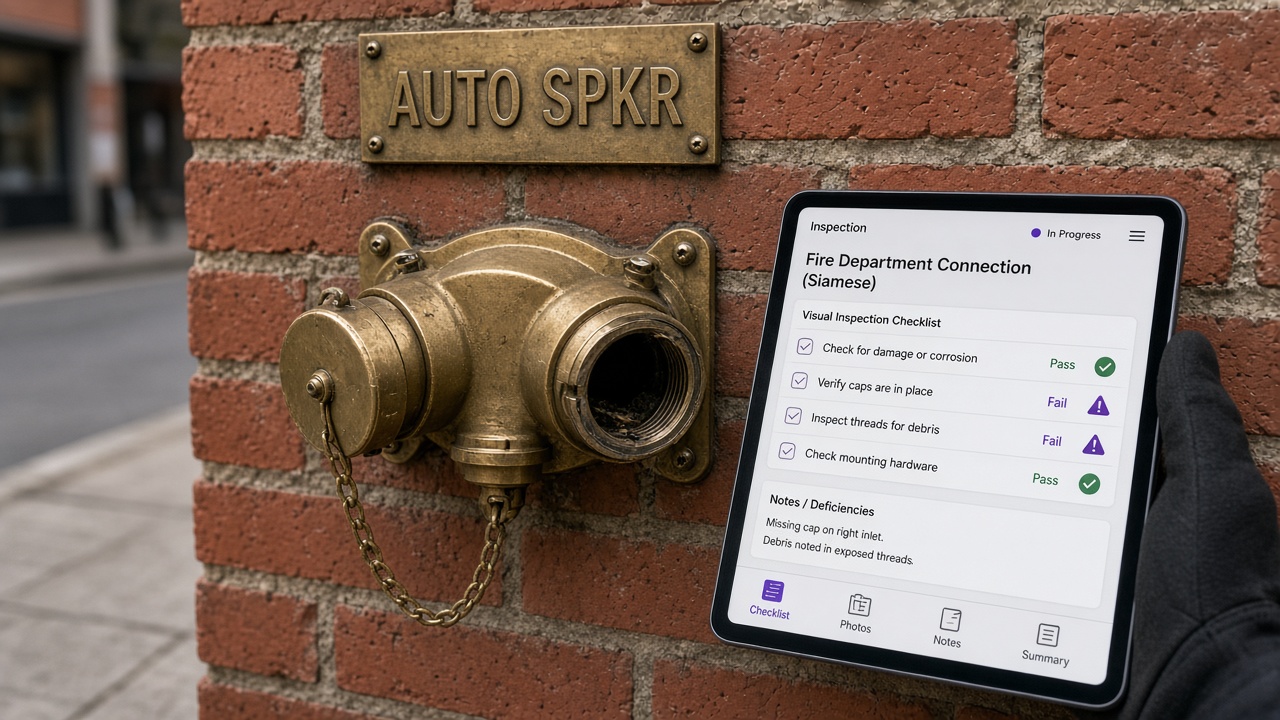
The fire department connection (FDC) is the brass inlet on the outside of the building that lets the fire department pump water into the sprinkler or standpipe system. It's also one of the easiest parts of the system to walk past. It sits outside, it gets hit by snowplows and delivery trucks, kids pull the caps off, and people stuff trash into the open inlets.
When the engine company pulls up, they're counting on that connection to work the first time. This fire department connection inspection checklist covers what techs should check at every FDC, what to write down, and which findings should become a deficiency and a quote. Frequencies and test requirements vary by NFPA 25 edition and local fire code, so always confirm what your AHJ has adopted and whether the local fire department has its own FDC rules.
What the FDC inspection is proving
A good FDC check answers three questions:
- Can the fire department find it and get to it?
- Will a hose actually connect to it?
- Will water get from the inlet into the system without leaking out or being blocked?
A quick glance from the parking lot answers none of those. The tech has to walk up, look inside, and put hands on it. Visual FDC checks are commonly a quarterly item in recent NFPA 25 editions, and they also belong on every sprinkler or standpipe visit. See NFPA 25 sprinkler inspection frequency for how that sits with the rest of the ITM calendar.
What to check at every visit
Visibility and access
- The FDC is visible from the street or fire lane and not hidden by landscaping, signs, dumpsters, snow piles, or parked vehicles.
- Clearance around it is enough for firefighters to connect hose and work.
- If the building has more than one FDC, each one is accounted for.
Signage
- The sign identifies what the FDC serves (for example, automatic sprinklers, standpipe, or a combination) and is readable.
- If the FDC doesn't serve the whole building, the sign says which areas it covers.
- Local fire codes often add their own sign requirements, such as the design pressure or a specific sign style. Check the local amendments, and keep them on the same jurisdiction list described in how cities adopt NFPA codes.
Caps, plugs, and couplings
- Caps or plugs are in place on every inlet.
- Swivels turn freely by hand and threads aren't damaged, cross-threaded, or painted over.
- Gaskets are present and in good condition.
- If the building uses locking FDC caps, note whether they're present and whether the fire department has the key.
Inside the inlets
- With caps off, look inside for trash, rocks, cans, nests, or anything else that could block flow. Missing caps are the biggest warning sign that something is inside.
- The clapper or check valves inside the inlet are present and seat properly.
Piping and valves
- The check valve in the FDC line isn't leaking.
- The automatic drain (ball drip) between the FDC and the check valve is working and not stuck or leaking. In cold climates, a stuck drain can mean trapped water and a frozen line, which is why this check belongs with winter freeze checks for fire sprinkler systems.
- There's no visible damage, leaking, or corrosion on exposed piping.
- If there's a control valve in the FDC line, it's in the correct position and supervised as required.
What to write down
"FDC OK" doesn't help anyone later. A useful FDC record includes:
- Location of each FDC (which elevation, which door, which street) and what it serves.
- Condition of caps or plugs, swivels, threads, and gaskets, inlet by inlet.
- Whether anything was found inside the inlets and whether it was removed.
- Condition of the ball drip and check valve.
- Sign condition and wording.
- Any access problems, with a photo.
- Date of the last FDC piping hydrostatic test, if the building has a record of one. NFPA 25 has a periodic hydrostatic test requirement for FDC piping, and the interval and test conditions depend on the edition, so note what's on file and when the next one is due.
Photos matter more on FDCs than almost anywhere else, because the office and the customer can see a missing cap or a blocked inlet instantly without a site visit.
Findings that should become a quote
These are the FDC issues that usually turn into billable work:
- Missing caps or plugs. Replace them, and if the inlets were open, note whether obstruction checking or flushing is needed per the adopted edition.
- Debris or obstructions in the inlets. Removal, and possibly flushing the FDC line.
- Seized swivels or damaged threads. Repair or replacement of the swivel or the inlet body.
- Missing or damaged clappers or gaskets.
- Leaking check valve or stuck ball drip.
- Missing, faded, or wrong signage.
- Blocked access from landscaping or site changes. Not always your repair, but the customer needs to know in writing.
- Overdue FDC hydrostatic test.
- Locking caps requested by the fire department or the customer.
Write each one the way the office can price it: what's wrong, where it is, how many, and what part or work is needed. "Right inlet cap missing on the 2-1/2 inch Siamese at the north entrance, threads debris-packed, needs cap plus flush" can be quoted the same day. "FDC needs work" turns into a callback. For the five details that make a finding priceable, see inspection deficiency notes that lead to quotes.
Frequently asked questions
How often should a fire department connection be inspected? Visual inspection of the FDC is commonly a quarterly NFPA 25 item, and it should also be checked on every sprinkler or standpipe visit. Periodic hydrostatic testing of FDC piping is a separate, longer-interval requirement. Confirm the adopted edition and any local fire-department rules.
What is the most common FDC deficiency? Missing caps or plugs, often with debris in the inlets. Blocked access, damaged swivels, faded signs, and a stuck ball drip in cold weather are also frequent finds.
Does a missing FDC cap require a flush of the line? Not automatically, but an open inlet is a warning that something may be inside. Look in the inlets, document what you find, and follow the adopted NFPA 25 edition for obstruction checking or flushing.
Who sets extra FDC rules, such as locking caps or special signs? The AHJ and the local fire department. Many cities add sign wording, thread type, or locking-cap requirements on top of NFPA 25. Check local amendments before you call a sign "OK."
How Optic helps
In Optic, techs work through FDC checklist items on their phone or tablet, attach photos to each finding, and write deficiencies that flow straight into an estimate. The office sees the missing cap, the photo, and the location without calling the tech, and the customer gets a quote while the inspection is still fresh.
If your FDC findings are still getting lost between the field and the office, see how Optic handles inspections and deficiencies.
This article is general guidance for fire protection professionals. Always follow the NFPA 25 edition and local amendments adopted by your Authority Having Jurisdiction, plus any fire-department FDC rules that apply to the property.