When building power drops, the fire alarm panel switches over to its standby batteries and has to keep supervising the system for hours, then still have enough left to sound every horn and strobe in an alarm. Those batteries usually sit in the bottom of the cabinet for years without anyone thinking about them, until a test shows they can't carry the load.
This post covers what fire alarm standby battery testing is actually proving, what techs should check and write down at every visit, and which results should become a deficiency and a quote. Test methods and frequencies vary by NFPA 72 edition and by the panel manufacturer, so always confirm the edition your AHJ has adopted and the manufacturer's instructions for the panel in front of you. For the wider ITM calendar, see NFPA 72 fire alarm inspection frequency.
What the battery test proves
Standby batteries have one job: carry the system through a loss of primary power for the required standby time, then power the alarm load. A visual check and a voltage reading on the charger don't prove that. A battery can read normal float voltage on the charger and still collapse the moment it has to carry real current.
That's why a good battery test answers three questions:
- Are the batteries in good physical condition and properly installed?
- Is the charger keeping them at the right charge without overcharging them?
- Can they actually deliver current under load, not just show voltage at rest?
Check the physical condition first
Before you put a meter or a load on anything, look:
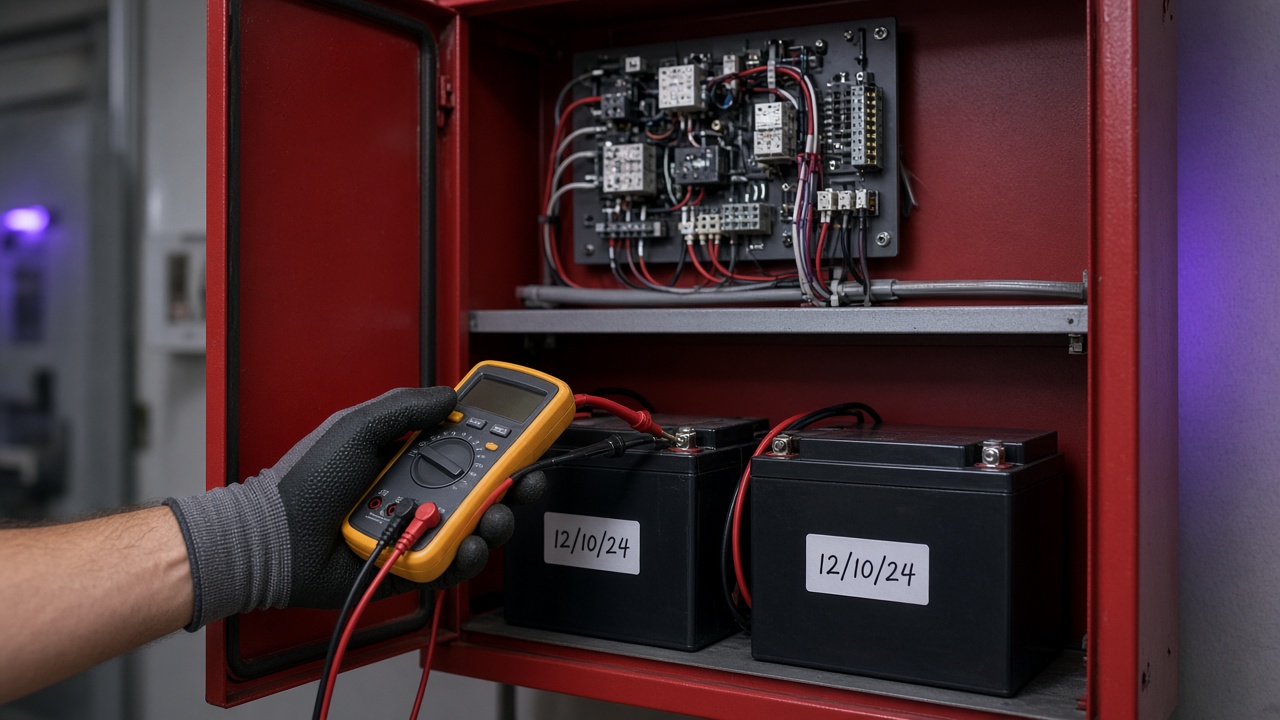
- Date codes. Note the install or manufacture date written on each battery. Sealed lead-acid batteries age out even if they still pass, and many contractors and manufacturers set a replacement interval. Undated batteries are worth flagging on their own.
- Swelling or cracking. A bulged case usually means the battery has been overcharged or overheated. It needs replacing, and the charger should be checked too.
- Leaks and corrosion. White or green buildup on the terminals or the cabinet floor is a deficiency, not a cleaning note.
- Terminals and wiring. Loose connections, missing terminal covers, and undersized jumpers all cause problems under load.
- Matching set. Batteries in a string should be the same make, rating, and age. One new battery wired in with an old one shortens the life of both.
Readings that belong on the report
"Batteries OK" doesn't help the next tech or the building owner. Record the numbers:
- Battery rating (amp-hour capacity) and whether it matches what the system needs, based on the battery calculation if one exists on file.
- Charger voltage with the batteries connected, and whether it's within the panel manufacturer's range.
- Charging current, if your meter or the panel shows it. High current on a supposedly charged set can point to a failing battery.
- Voltage of each battery at rest, and again under load.
- Load test result. Whether you used the panel's built-in battery test, a battery load tester, or a conductance or impedance tester, write down the method and the result, not just pass or fail.
The method matters because results from different methods aren't directly comparable. If one tech uses a conductance tester and the next uses the panel's self-test, the trend over the years gets muddy.
Don't skip the AC power-loss check
The most direct proof is also the one most often skipped: disconnect primary power (with the monitoring company and the building notified) and confirm the panel transfers to batteries without dropping out, shows the correct trouble signal, and still operates. Restore power and confirm the charger picks back up and the trouble clears.
It takes a few extra minutes, but it shows the whole chain works, not just the batteries on their own.
Results that should become a deficiency
These findings shouldn't be buried in the notes. Each should be its own deficiency with a clear recommendation:
- Batteries past the contractor's or manufacturer's replacement age, or with no date at all
- Swollen, cracked, leaking, or corroded batteries
- Voltage under load that falls below the manufacturer's acceptable level
- A failed panel battery test or load test
- Charger voltage out of range, or a charger that isn't charging
- Mismatched batteries in the same string
- Battery capacity smaller than the system's calculated requirement
- Batteries in remote power supplies (NAC panels) that were never tested
Remote power supplies are the easy ones to miss. A building can have a healthy main panel and three booster panels running on batteries nobody has touched in six years.
Turning battery findings into quotes
Battery replacement is one of the simplest repairs to price, which makes it one of the easiest to lose when the note is vague. "Batteries weak" makes the office call the tech back. A note that says "Main FACP: two 12V 18Ah batteries, dated 2019, 11.2V under load, failed panel battery test. Replace both." can be priced the same day.
Listing every panel and power supply with its battery size and date also lets the office quote the whole building at once instead of one cabinet at a time. That's the same standard as any other inspection deficiency note that leads to a quote. If you also service the sprinkler system in the building, make sure waterflow and supervisory tests line up with the fire alarm record, as described in the NFPA 25 sprinkler inspection frequency guide.
Frequently asked questions
How often should fire alarm standby batteries be tested? It depends on the battery type and the adopted NFPA 72 edition, plus the panel manufacturer's instructions. Don't reduce the test to a float-voltage reading on the charger. Record the method and the result at every required visit.
Can a battery pass a voltage check and still fail under load? Yes. A set can show normal charger voltage and still collapse when it has to carry current. That's why a load test, a conductance or impedance test, or the panel's battery test — with the method written down — matters more than "batteries OK."
Should remote NAC power supplies be tested too? Yes. Every cabinet with standby batteries should be on the list: the main fire alarm control panel and every booster or remote power supply. These are the batteries most often skipped.
When should fire alarm batteries be replaced? When they fail a test, show physical damage, are undated, are mismatched, are undersized for the calculation, or have passed the manufacturer or contractor replacement age. Quote the whole string, not one jar at a time.
How Optic helps
In Optic, techs record battery details right inside the fire alarm inspection: the size, the date code, the readings, and the test method for each panel and power supply. A failed test or an expired date is logged as a deficiency with photos attached, and the office can turn it into an estimate without retyping anything. Because the readings are saved at every visit, you can see which buildings have batteries coming due before they fail.
Batteries are cheap. A fire alarm system that goes dark during a power outage is not. Test them like they matter, write down the numbers, and make sure every failed set turns into a quote. If those readings still live on a paper ticket, see how Optic handles inspections.
This article is general guidance for fire protection professionals. Always follow the NFPA 72 edition and local amendments adopted by your Authority Having Jurisdiction, plus the panel and battery manufacturers' instructions.